I occasionally see people claim that socialism is an ideal system that is held back by selfish people. That's not the only reason it fails, and even if people were as selfless as socialists like to pretend they are (or somehow would be under socialism, at any rate), it still wouldn't work.
A big part of this is the problem of calculating opportunity cost. Capitalists pushing capital toward whatever is making an economic profit, and firms producing goods until the marginal cost of production is equal to the price, create a system where the opportunity cost of production and the opportunity cost of consumption are quite similar, and this is indicated by prices. Consumers ultimately direct resources according to their own preferences, and those preferences end up taking the opportunity cost of production into account even though the consumers are only concerned with the opportunity cost of consuming one good rather than another. Any system without capital markets and profit-seeking firms loses this functionality, as does any system where prices are set by any other method.
Now, some firms are able to wring a little extra money out of things by virtue of market power giving them a profit-maximizing level of production that is reached before they hit the point where price equals marginal cost, but this is actually a pretty small thing. The average net profit margin across all industries is only 8%. What this means is that while there is some wiggle room, it's accurate enough to work well.
Under socialism, you do not and cannot know the opportunity cost of production. Whether you've got the central-planning style of socialism or some kind of democratically controlled system makes no difference; the mechanism that allows us to discover the opportunity costs of production is born of the interaction between capital markets and profit-seeking firms.
Tuesday, December 31, 2019

Wednesday, February 14, 2018
For Every Apostate, a Facebook Group
There is a guy I've come across who every now and then
will mingle up his scripture with philosophies of men
In Sunday school we roll our eyes when he brings up his views
on politics or random crap reported by the news
He disregards the text and mostly reads between the lines
'cause that's the part that talks about the gospel's REAL designs
He thinks he's got a better read on being truly pious
while blinded by his omnipresent confirmation bias
He contradicts inspired words from more official sources
with snippets out of context from the Journal of Discourses
The chicken of philosophy has flown the gospel coop,
his nostrils flare and he declares, "I'll start a Facebook group!"
will mingle up his scripture with philosophies of men
In Sunday school we roll our eyes when he brings up his views
on politics or random crap reported by the news
He disregards the text and mostly reads between the lines
'cause that's the part that talks about the gospel's REAL designs
He thinks he's got a better read on being truly pious
while blinded by his omnipresent confirmation bias
He contradicts inspired words from more official sources
with snippets out of context from the Journal of Discourses
The chicken of philosophy has flown the gospel coop,
his nostrils flare and he declares, "I'll start a Facebook group!"
Sunday, December 31, 2017
Post-Recession Recovery Under Reagan and Obama
Reagan and Obama both started their terms with recessions; Obama in 2009 and Reagan in 1982, which makes for a useful out-of-the-trough comparison for economic growth afterward. Obama's recession was deeper, giving him an advantage at the start, but even with the handicap, Reagan outperformed Obama by two to one in GDP growth and median personal income growth.
The years following the recessions (1983-1988 and 2010-2016), Reagan's economy grew at an average of 4.55% annually while Obama's economy grew at an average of 2.14% annually.
Obama's best year for growth, 2.9% in 2015, was worse than all but two of Reagan's years (1981-1982). After the recession, Reagan spent every year between 3.5% and 7.3% GDP growth. Obama's post-recession growth ranged from 1.5% to 2.9%.
But let's suppose you don't care about GDP. Let's look at median personal income; what the guy in the middle takes home, adjusted for inflation.
Real median personal income under Reagan increased from $21,627 to $25,905 in 2016 dollars, an increase of 19.7%. If we just count the post-recession years, it grew by 16.2%.
Under Obama, real median personal income increased from $29,235 to $31,099 in 2016 dollars, an increase of 6.3%. If we just count the post-recession years, it grew by 7.9%.
Or maybe you don't care about GDP or how the middle class is doing; you'd rather just attribute Reagan's success to deficit spending, and think that Obama would have been successful if he just spent some more money. Well, Reagan increased the national debt by 19% of GDP. Obama increased the national debt by 26% of GDP.
The people who call Reagan's policies a failure never seem to mention that median personal income and the economy as a whole grew more than twice as much under Reagan's recovery as they did under Obama's recovery. Obama's most notable economic achievement is being the only president since we started tracking GDP in 1929 to never have a single year of 3% GDP growth, and he had two terms to manage not to do it.
The years following the recessions (1983-1988 and 2010-2016), Reagan's economy grew at an average of 4.55% annually while Obama's economy grew at an average of 2.14% annually.
Obama's best year for growth, 2.9% in 2015, was worse than all but two of Reagan's years (1981-1982). After the recession, Reagan spent every year between 3.5% and 7.3% GDP growth. Obama's post-recession growth ranged from 1.5% to 2.9%.
But let's suppose you don't care about GDP. Let's look at median personal income; what the guy in the middle takes home, adjusted for inflation.
Real median personal income under Reagan increased from $21,627 to $25,905 in 2016 dollars, an increase of 19.7%. If we just count the post-recession years, it grew by 16.2%.
Under Obama, real median personal income increased from $29,235 to $31,099 in 2016 dollars, an increase of 6.3%. If we just count the post-recession years, it grew by 7.9%.
Or maybe you don't care about GDP or how the middle class is doing; you'd rather just attribute Reagan's success to deficit spending, and think that Obama would have been successful if he just spent some more money. Well, Reagan increased the national debt by 19% of GDP. Obama increased the national debt by 26% of GDP.
The people who call Reagan's policies a failure never seem to mention that median personal income and the economy as a whole grew more than twice as much under Reagan's recovery as they did under Obama's recovery. Obama's most notable economic achievement is being the only president since we started tracking GDP in 1929 to never have a single year of 3% GDP growth, and he had two terms to manage not to do it.
Tuesday, August 9, 2016
I Have Accidentally Committed Priestcraft
Night shift story time again! I'm just gonna do the long rambling
version, full of fun and adventure, and also barely-connected tangents
given in nigh-incomprehensible style (I LOVE PARENTHESES SO MUCH)!
So this guest came up to the front desk and said that his wife knew nothing about the Mormon faith but she was interested in the Book of Mormon. We have 'em in our rooms because Utah, along with the Bibles that the Gideons leave (by the way, I've worked at a bunch of hotels and I don't think I've ever actually seen a Gideon; I think they must be ninjas. Also, the Bible Dictionary says that "Gideon" means "hewer down of men" which is basically "man-mower" and I don't think I'd want to mess with that. So... probably ninjas) but in this case somebody had written in the one in their room and they were wondering if they could have one to keep. In my head I'm going "OH MY GOSH I COULD HAVE USED A FEW MORE PEOPLE LIKE YOU WHEN I WAS A MISSIONARY" and I scrambled around a bit at the desk to find the box of extras that we keep on hand, but they were nowhere to be found. PROBABLY Satan's doing, is what I'm saying. Either that or it was housekeeping's fault somehow. Basically all the evils in the world originate from either Satan or the Fairfield housekeeping department. Except when it's Dave, who I suspect has ties to both of those things. (Did I mention that I asked Dave to get us a mop? He got us one! And it's TINY. I'm looking this gift horse in the mouth and I can't even see if there are teeth in there, it's so small)
Anyway, I check the system and find an unoccupied room, make myself a key, and run over there to get a Book of Mormon, because somebody's eternal salvation is at stake here (but not really because they'd get a chance even if I drop the ball, but they'd have to wait who knows how long for that bus to come by again, you know? And what are the odds of some random person in Utah being willing to give them a Book of Mormon anyway? It's 55% according to a recent Pew Research survey on religiosity of adults in Utah) and when I get to the room, I check the drawer and the only thing that's in there is the Bible. "WHY IS THERE JUST THE STICK OF JUDAH IN HERE!?" I don't completely dismiss the possibility that it was taken by our housekeepers, who are basically the Mongol Horde with cleaning carts and fingers so sticky they could probably scale a sheer glass surface (like geckos, except that geckos don't have sticky fingers, they use something called van der Waals forces to take advantage of attraction between atoms which is totally sweet, but housekeeping has sticky fingers in the figurative sense in that they steal anything that isn't nailed down, and if it IS nailed down then HEY LOOK FREE NAILS) and I'm basically never above blaming housekeeping for things not being where they ought to be.
Suddenly it occurs to me that we had the big Jehovah's Witness convention a couple of weeks ago (¡En Inglés YYYYY Español!), and it wouldn't have occurred to me to blame them except we actually had a couple of them come down and ask if they could leave the Book of Mormon at the front desk because they didn't want to be in the same room with it. So maybe it was them one or maybe somebody else in the group saw a chance to strike a blow for Jesus/Jesús and took it home to burn it or something. Pretty nice guests for the most part, though.
I run back to the desk and get another room key for a different room. The guest is like "If you can't find one, it's okay" because he obviously doesn't grasp the SERIOUSNESS OF THE SITUATION. If I can't give a Book of Mormon to a guy who is literally standing there asking for one, I'll basically be the worst Mormon ever. I'm already not doing so hot on account of that whole hating my neighbor thing (seriously it's like RULE #2 so it's kind of a big deal. I don't mean my actual neighbors; in the three years since I've lived where I am now I have spoken to them all a grand total of zero times, which is awesome, and in my last apartment I only talked to my neighbors once and that was when they accidentally locked themselves out of their apartment with their baby inside and so I broke in with a butter knife in like 30 seconds LIKE A HERO).
Fortunately the second room had one, and I checked to make sure nobody had written garbage in this one, but it was cool. You can't foil me this time, housekeeping/Satan/Dave/JW Convention (¡En Inglés YYYYY Español!) I was feeling pretty good about everything when suddenly he gave me a tip. Three whole dollars. Which means I have now committed priestcraft, spreading religion for filthy lucre, and my efforts at being Not the Worst Mormon Ever were all for naught. When he asked about it being missing from the first room I told him that I suspected that the Jehovah's Witnesses took it, and he told me that every Jehovah's Witness he's ever met has been completely crazy. I told him, "They have a very... insular culture." He told me I had a lot of tact, and I told him that it's my job, which means I stop doing it when I clock out.
The front desk supervisor has been back from her mission for like a year or something, and when she came in to work this morning after all of this was over with I was like "I GAVE A GUEST A BOOK OF MORMON" and she got this look on her face that was halfway between "THAT'S AWESOME" and "My best night auditor is proselyting behind the counter at work, I am going to have to fire him and the hotel will surely fail." Then I told her that he had asked for one and that I accidentally committed priestcraft because he tipped me, and she laughed a bunch at that. I was having such a good time with my own cleverness that I forgot about the cash drawer key in my pocket and drove all the way home with it, and had to spend 20 minutes driving it back. Thanks a lot, housekeeping. Jerks.
So this guest came up to the front desk and said that his wife knew nothing about the Mormon faith but she was interested in the Book of Mormon. We have 'em in our rooms because Utah, along with the Bibles that the Gideons leave (by the way, I've worked at a bunch of hotels and I don't think I've ever actually seen a Gideon; I think they must be ninjas. Also, the Bible Dictionary says that "Gideon" means "hewer down of men" which is basically "man-mower" and I don't think I'd want to mess with that. So... probably ninjas) but in this case somebody had written in the one in their room and they were wondering if they could have one to keep. In my head I'm going "OH MY GOSH I COULD HAVE USED A FEW MORE PEOPLE LIKE YOU WHEN I WAS A MISSIONARY" and I scrambled around a bit at the desk to find the box of extras that we keep on hand, but they were nowhere to be found. PROBABLY Satan's doing, is what I'm saying. Either that or it was housekeeping's fault somehow. Basically all the evils in the world originate from either Satan or the Fairfield housekeeping department. Except when it's Dave, who I suspect has ties to both of those things. (Did I mention that I asked Dave to get us a mop? He got us one! And it's TINY. I'm looking this gift horse in the mouth and I can't even see if there are teeth in there, it's so small)
Anyway, I check the system and find an unoccupied room, make myself a key, and run over there to get a Book of Mormon, because somebody's eternal salvation is at stake here (but not really because they'd get a chance even if I drop the ball, but they'd have to wait who knows how long for that bus to come by again, you know? And what are the odds of some random person in Utah being willing to give them a Book of Mormon anyway? It's 55% according to a recent Pew Research survey on religiosity of adults in Utah) and when I get to the room, I check the drawer and the only thing that's in there is the Bible. "WHY IS THERE JUST THE STICK OF JUDAH IN HERE!?" I don't completely dismiss the possibility that it was taken by our housekeepers, who are basically the Mongol Horde with cleaning carts and fingers so sticky they could probably scale a sheer glass surface (like geckos, except that geckos don't have sticky fingers, they use something called van der Waals forces to take advantage of attraction between atoms which is totally sweet, but housekeeping has sticky fingers in the figurative sense in that they steal anything that isn't nailed down, and if it IS nailed down then HEY LOOK FREE NAILS) and I'm basically never above blaming housekeeping for things not being where they ought to be.
Suddenly it occurs to me that we had the big Jehovah's Witness convention a couple of weeks ago (¡En Inglés YYYYY Español!), and it wouldn't have occurred to me to blame them except we actually had a couple of them come down and ask if they could leave the Book of Mormon at the front desk because they didn't want to be in the same room with it. So maybe it was them one or maybe somebody else in the group saw a chance to strike a blow for Jesus/Jesús and took it home to burn it or something. Pretty nice guests for the most part, though.
I run back to the desk and get another room key for a different room. The guest is like "If you can't find one, it's okay" because he obviously doesn't grasp the SERIOUSNESS OF THE SITUATION. If I can't give a Book of Mormon to a guy who is literally standing there asking for one, I'll basically be the worst Mormon ever. I'm already not doing so hot on account of that whole hating my neighbor thing (seriously it's like RULE #2 so it's kind of a big deal. I don't mean my actual neighbors; in the three years since I've lived where I am now I have spoken to them all a grand total of zero times, which is awesome, and in my last apartment I only talked to my neighbors once and that was when they accidentally locked themselves out of their apartment with their baby inside and so I broke in with a butter knife in like 30 seconds LIKE A HERO).
Fortunately the second room had one, and I checked to make sure nobody had written garbage in this one, but it was cool. You can't foil me this time, housekeeping/Satan/Dave/JW Convention (¡En Inglés YYYYY Español!) I was feeling pretty good about everything when suddenly he gave me a tip. Three whole dollars. Which means I have now committed priestcraft, spreading religion for filthy lucre, and my efforts at being Not the Worst Mormon Ever were all for naught. When he asked about it being missing from the first room I told him that I suspected that the Jehovah's Witnesses took it, and he told me that every Jehovah's Witness he's ever met has been completely crazy. I told him, "They have a very... insular culture." He told me I had a lot of tact, and I told him that it's my job, which means I stop doing it when I clock out.
The front desk supervisor has been back from her mission for like a year or something, and when she came in to work this morning after all of this was over with I was like "I GAVE A GUEST A BOOK OF MORMON" and she got this look on her face that was halfway between "THAT'S AWESOME" and "My best night auditor is proselyting behind the counter at work, I am going to have to fire him and the hotel will surely fail." Then I told her that he had asked for one and that I accidentally committed priestcraft because he tipped me, and she laughed a bunch at that. I was having such a good time with my own cleverness that I forgot about the cash drawer key in my pocket and drove all the way home with it, and had to spend 20 minutes driving it back. Thanks a lot, housekeeping. Jerks.
Thursday, December 31, 2015
I Don't Much Like Christmas Anymore
So with the year winding down, I decided to write a little about my thoughts on Christmas and a few other things. Specifically, Christmas as a sort of social barometer.
Christmas is both a religious and a secular holiday, but you wouldn't know it from the presentation of Christmas in the public sphere. This year I noticed that while as always Christmas music was absolutely everywhere, it was always of the lamest secular variety: Britney Spears singing a song to Santa about how good she's been this year and similar garbage. These are the depths we've sunk to in a desperate bid to not offend people by playing O Holy Night, God Rest ye Merry Gentlemen, or even something as vaguely benign as Good King Wenceslas. Whatever.
Something that has been bothering me for a lot longer is the insane consumer frenzy associated with Christmas. We have Thanksgiving to get all of the gratitude out of our system so the very next day we can launch ourselves into the most crass display of consumerism of the entire year: Black Friday. It's the sort of animalistic savagery best narrated by Sir David Attenborough.
It's not particularly surprising that Christmas feeds into this, as many companies are reliant upon Christmas spending to stay afloat. Being of a free market capitalist persuasion ideologically, I am aware that the success or failure of a business should be determined by whether it is making efficient use of resources to satisfy consumer demands. But that just brings to the fore the reality that without people spending exorbitant amounts of money on crap every year, these companies would not, and should not, exist as they currently do. This means they have a tremendous incentive to maintain the status quo of Christmas as a months-long shopping spree. This is why you start hearing Christmas music in some stores sometime around Halloween, and the day after Christmas it's basically everywhere.
I wouldn't say that businesses are solely to blame for this; consumers want to buy stuff for Christmas, so companies provide it, but they in turn fan the flames for all they're worth so people want to buy more stuff for Christmas. It's a mutually reinforcing relationship, I think. And I think it sucks, largely because the values of the people involved are garbage. More on that in a minute.
Among the capitalist free market crowd, contempt for consumerism is relatively rare. A lot of people don't even make a distinction between private ownership of capital; that is, relegating the risks and rewards of entrepreneurial activity to individuals rather than society in aggregate, with the kind of crass materialism embodied in contemporary Christmas.
The root of the problem is that people are inherently hierarchical, and there is no solution for this. Every society has means of establishing a pecking order of sorts; it could be something formalized like a caste system, it could be adherence to a dominant ideology within a group, or it could just be buying the most expensive crap you can get your hands on and showing it off so everyone knows how "successful" you are. It's the time-honored tradition of spending money you don't have on stuff you can't afford to impress people you don't like.
In the United States, in the absence of some other system of values people seem to default to the accumulation of stuff as the measure of success, so wealth and status are highly connected. This leads to things like people accumulating credit card debt to temporarily maintain a lifestyle beyond what they can afford, burying themselves in mortgage debt to get a bigger house than they really need, or competing for status with expensive clothing while relying on payday loans to make it through the week. All of this crap is devastating on both an individual and a social level.
When people signal their status with the crap they buy and savings accounts don't even beat inflation, any temporary bump in unemployment brings with it a decline in demand because nobody has any savings. It makes the economy brittle. This is a consequence of the materialistic values of our society and our system of fractional reserve banking which undermines the incentives for saving by removing the need for banks to attract deposits in order to finance lending.
So, I can see the appeal of trying to get rid of income as a barometer for success, but if it were gone people would just latch onto some other dumb thing to show how much better they are than everybody else, which is probably a lot of the impetus behind the recent rise in nutjob ideologies that tend to flourish in insular online cabals; militant feminism, "social justice" and whatever else. Replacing materialism with the other stupid signaling games these people play still wouldn't fix the problem of people not having any savings and getting wiped out the first time it rains, since I think that problem is mostly caused by the downright insulting interest rates that banks need to offer in order to cover their minimum reserve requirements. As such, I think the materialism is more of a consequence of the lack of other values by which people would construct their little hierarchies, but that the popular alternatives aren't any better. I'd much rather work with some douchebag who thinks his new car makes him a better person instead of working with a social justice warrior; the first is content to think he's better because he bought some crap, while the second wants the total ideological subjugation of everyone. It's more tolerable to work with someone who wants to talk about the stuff he bought than it is to work with a zealot.
Christmas is both a religious and a secular holiday, but you wouldn't know it from the presentation of Christmas in the public sphere. This year I noticed that while as always Christmas music was absolutely everywhere, it was always of the lamest secular variety: Britney Spears singing a song to Santa about how good she's been this year and similar garbage. These are the depths we've sunk to in a desperate bid to not offend people by playing O Holy Night, God Rest ye Merry Gentlemen, or even something as vaguely benign as Good King Wenceslas. Whatever.
Something that has been bothering me for a lot longer is the insane consumer frenzy associated with Christmas. We have Thanksgiving to get all of the gratitude out of our system so the very next day we can launch ourselves into the most crass display of consumerism of the entire year: Black Friday. It's the sort of animalistic savagery best narrated by Sir David Attenborough.
It's not particularly surprising that Christmas feeds into this, as many companies are reliant upon Christmas spending to stay afloat. Being of a free market capitalist persuasion ideologically, I am aware that the success or failure of a business should be determined by whether it is making efficient use of resources to satisfy consumer demands. But that just brings to the fore the reality that without people spending exorbitant amounts of money on crap every year, these companies would not, and should not, exist as they currently do. This means they have a tremendous incentive to maintain the status quo of Christmas as a months-long shopping spree. This is why you start hearing Christmas music in some stores sometime around Halloween, and the day after Christmas it's basically everywhere.
I wouldn't say that businesses are solely to blame for this; consumers want to buy stuff for Christmas, so companies provide it, but they in turn fan the flames for all they're worth so people want to buy more stuff for Christmas. It's a mutually reinforcing relationship, I think. And I think it sucks, largely because the values of the people involved are garbage. More on that in a minute.
Among the capitalist free market crowd, contempt for consumerism is relatively rare. A lot of people don't even make a distinction between private ownership of capital; that is, relegating the risks and rewards of entrepreneurial activity to individuals rather than society in aggregate, with the kind of crass materialism embodied in contemporary Christmas.
The root of the problem is that people are inherently hierarchical, and there is no solution for this. Every society has means of establishing a pecking order of sorts; it could be something formalized like a caste system, it could be adherence to a dominant ideology within a group, or it could just be buying the most expensive crap you can get your hands on and showing it off so everyone knows how "successful" you are. It's the time-honored tradition of spending money you don't have on stuff you can't afford to impress people you don't like.
In the United States, in the absence of some other system of values people seem to default to the accumulation of stuff as the measure of success, so wealth and status are highly connected. This leads to things like people accumulating credit card debt to temporarily maintain a lifestyle beyond what they can afford, burying themselves in mortgage debt to get a bigger house than they really need, or competing for status with expensive clothing while relying on payday loans to make it through the week. All of this crap is devastating on both an individual and a social level.
When people signal their status with the crap they buy and savings accounts don't even beat inflation, any temporary bump in unemployment brings with it a decline in demand because nobody has any savings. It makes the economy brittle. This is a consequence of the materialistic values of our society and our system of fractional reserve banking which undermines the incentives for saving by removing the need for banks to attract deposits in order to finance lending.
So, I can see the appeal of trying to get rid of income as a barometer for success, but if it were gone people would just latch onto some other dumb thing to show how much better they are than everybody else, which is probably a lot of the impetus behind the recent rise in nutjob ideologies that tend to flourish in insular online cabals; militant feminism, "social justice" and whatever else. Replacing materialism with the other stupid signaling games these people play still wouldn't fix the problem of people not having any savings and getting wiped out the first time it rains, since I think that problem is mostly caused by the downright insulting interest rates that banks need to offer in order to cover their minimum reserve requirements. As such, I think the materialism is more of a consequence of the lack of other values by which people would construct their little hierarchies, but that the popular alternatives aren't any better. I'd much rather work with some douchebag who thinks his new car makes him a better person instead of working with a social justice warrior; the first is content to think he's better because he bought some crap, while the second wants the total ideological subjugation of everyone. It's more tolerable to work with someone who wants to talk about the stuff he bought than it is to work with a zealot.
Thursday, July 17, 2014
How Well Would a Gun Ban Work, Anyway?
Today I was having a debate with somebody on the Internet about gun control, and it led me to do some research that I found interesting enough to share.
I brought up the fact that Chicago had banned handguns for decades and was still swimming in them, to which he replied that making handguns illegal doesn't mean anything if people are allowed to bring them in from outside. "There are no police checkpoints where they check for handguns," and so on.
I said that it was illegal to possess an unregistered handgun and that Chicago didn't allow anyone to register handguns, so people weren't actually allowed to bring them into the city legally. I also pointed out that he had just conceded that a handgun ban is ineffective without some serious police-state apparatus, to which he replied that you could just ban them nationwide and not have to worry about police checkpoints in your cities. You could have checkpoints at the border, and pretend that we can't just make handguns with our huge stockpile of machine tools.
But how well does that approach work, really? He insists it would work, I say it wouldn't, nobody has any evidence to present against his hypothetical scenario. At least, that's how it would play out if I weren't totally freaking awesome. I finally found a productive use for the War on Drugs: providing a quantitative measure of just how much the government sucks at stopping contraband.
Here's where the research comes in. I picked 2012 as the year for grabbing my data, because it's pretty recent but no so recent that the various public agencies haven't gotten around to publishing their annual reports (which often show up halfway through the next year, or later).
The Federal government commissioned the RAND corporation, a research institute, to estimate the size of the illegal drug market in the United States. Well, part of it, since they just focused on four major drugs: marijuana, cocaine (including crack), heroin, and meth. They came up with (paraphrasing here) "About $108 billion, give or take we-don't-know-how-much, in 2010 dollars."
Unfortunately their data didn't go to 2012. Two years shouldn't make that much difference, and the tendency is for markets to grow with time rather than shrink, so this is gives the DEA two years worth of wiggle room. I couldn't find 2010 data on DEA drug seizures because the DEA website is worthless (more on that in a bit).
So now that we have a ballpark figure for the street value of the illegal drug trade in the US (part of it, anyway), we can check with the DEA and see what the street value of all the drugs they confiscated in 2012 is, thus giving us a reasonable estimate of what percentage of illegal drugs make it to market vs getting found and confiscated by various police forces reporting their statistics to the DEA.
It turns out that the answer to this question is: basically nothing. In 2012 the DEA reported to Congress that they confiscated $2.8 billion (in 2012 dollars, natch) related to drug busts, of which $750 million was cash. So, with some generous rounding (what's $50 million in government figures, anyway?), they snagged $2.1 billion worth of drugs and non-cash property in 2012. This figure includes cars, homes, ships, airplanes, pretty much anything owned by drug dealers or smugglers (they actually bagged a submarine back in 2006, one out of apparently many). But since the DEA didn't say how much of the loot was actually drugs, and how much of the drugs were the type of drugs that we were including in our estimate of the total size of the drug market, we'll have to just give them the benefit of the doubt and assume that the whole non-cash take was drugs, specifically of the type that we were including before. At every step we are giving the DEA the benefit of the doubt because even with all of those unrealistically favorable estimates, they still only confiscate about 2% of the drugs. In reality, it's probably half that or less, but it really doesn't matter since we've got so much room to overestimate their effectiveness without actually making them seem like they are making a difference.
I tried pulling up the data from the DEA website, but it is a useless pit of spin and back-patting that didn't even have data on the street value of the drugs they confiscated. I suppose that the DEA providing this data alongside estimates of how large the drug trade is would show people just how ineffective the DEA is at actually reducing the illegal drug trade. Instead, they are busy doing things like trumpeting the decline in cocaine use over the last few years and ignoring the data that suggests that crackheads have just moved on to other drugs instead. Government websites are usually pretty good about disseminating useful data, but the DEA website seems less focused on dissemination and more interested on dissimulation. Specifically, trying to show that the DEA isn't ridiculously ineffective. If I could make comparisons to the street value of the drugs they seized, I would. They list some kind of vague quantities (how much is a "hallucinogenic dose" exactly?) but don't really go into detail about how much it's all worth. The difficulty in comparing data isn't entirely their fault; the RAND study should have listed quantities instead of just street value, but since their reporting doesn't reek of disingenuous attempts at obfuscation I'm willing to give them a pass on the inconvenience.
So then, now that we have established that the odds of the DEA intercepting drugs before they are consumed are, at best, about 50 to 1 against, even with their casual disregard for civil liberties (they'll send a SWAT team to kick in your door based on nothing more than an anonymous tip, which has led to the practice of Swatting people you don't like, or just for jollies) we can start making guesses about how effective they would be at intercepting smuggled weapons.
My guess is: not very. Guns are usually made of commonly used polymers and steel, so new guns tend to smell like the things you would smuggle them in. Dogs can sniff out gunpowder, allowing them to find a gun that has been fired, but new guns (and properly cleaned guns) don't smell like that. Drugs are produced in conditions that serve no other purpose; a meth lab is obviously used for producing meth, an underground hydroponics farm is obviously used for growing pot, and so on. Guns are produced with machine tools that have a huge variety of legal uses, so finding out that somebody has a machine shop in his garage isn't proof that he's a black market gunsmith. Even low-explosives like gunpowder have legal uses; fireworks and such. If 3D printing advances to the point where we can make guns that don't suck (because we can already 3D print crappy guns), the source of guns will only get harder to contain.
All of this adds up to guns, particularly handguns, being a lot harder to deal with as contraband, but even if by some miracle the government was able to increase the effectiveness of a "War on Guns" by a factor of ten compared to its War on Drugs, it'd still only be getting about one out of five. Chicago's decades-long effort to ban handguns was ineffective (until it was put out of its misery by the Supreme Court in 2010, on 2nd Amendment grounds), and expanding that policy nationwide, even if it weren't a blatant violation of the 2nd Amendment, would likely be no more effective than the War on Drugs has been.
A ban on guns would serve much the same purpose as the ban on drugs: to make a fretful populace feel like politicians are "doing something" about the situation, no matter how futile those efforts may be.
I brought up the fact that Chicago had banned handguns for decades and was still swimming in them, to which he replied that making handguns illegal doesn't mean anything if people are allowed to bring them in from outside. "There are no police checkpoints where they check for handguns," and so on.
I said that it was illegal to possess an unregistered handgun and that Chicago didn't allow anyone to register handguns, so people weren't actually allowed to bring them into the city legally. I also pointed out that he had just conceded that a handgun ban is ineffective without some serious police-state apparatus, to which he replied that you could just ban them nationwide and not have to worry about police checkpoints in your cities. You could have checkpoints at the border, and pretend that we can't just make handguns with our huge stockpile of machine tools.
But how well does that approach work, really? He insists it would work, I say it wouldn't, nobody has any evidence to present against his hypothetical scenario. At least, that's how it would play out if I weren't totally freaking awesome. I finally found a productive use for the War on Drugs: providing a quantitative measure of just how much the government sucks at stopping contraband.
Here's where the research comes in. I picked 2012 as the year for grabbing my data, because it's pretty recent but no so recent that the various public agencies haven't gotten around to publishing their annual reports (which often show up halfway through the next year, or later).
The Federal government commissioned the RAND corporation, a research institute, to estimate the size of the illegal drug market in the United States. Well, part of it, since they just focused on four major drugs: marijuana, cocaine (including crack), heroin, and meth. They came up with (paraphrasing here) "About $108 billion, give or take we-don't-know-how-much, in 2010 dollars."
Unfortunately their data didn't go to 2012. Two years shouldn't make that much difference, and the tendency is for markets to grow with time rather than shrink, so this is gives the DEA two years worth of wiggle room. I couldn't find 2010 data on DEA drug seizures because the DEA website is worthless (more on that in a bit).
So now that we have a ballpark figure for the street value of the illegal drug trade in the US (part of it, anyway), we can check with the DEA and see what the street value of all the drugs they confiscated in 2012 is, thus giving us a reasonable estimate of what percentage of illegal drugs make it to market vs getting found and confiscated by various police forces reporting their statistics to the DEA.
It turns out that the answer to this question is: basically nothing. In 2012 the DEA reported to Congress that they confiscated $2.8 billion (in 2012 dollars, natch) related to drug busts, of which $750 million was cash. So, with some generous rounding (what's $50 million in government figures, anyway?), they snagged $2.1 billion worth of drugs and non-cash property in 2012. This figure includes cars, homes, ships, airplanes, pretty much anything owned by drug dealers or smugglers (they actually bagged a submarine back in 2006, one out of apparently many). But since the DEA didn't say how much of the loot was actually drugs, and how much of the drugs were the type of drugs that we were including in our estimate of the total size of the drug market, we'll have to just give them the benefit of the doubt and assume that the whole non-cash take was drugs, specifically of the type that we were including before. At every step we are giving the DEA the benefit of the doubt because even with all of those unrealistically favorable estimates, they still only confiscate about 2% of the drugs. In reality, it's probably half that or less, but it really doesn't matter since we've got so much room to overestimate their effectiveness without actually making them seem like they are making a difference.
I tried pulling up the data from the DEA website, but it is a useless pit of spin and back-patting that didn't even have data on the street value of the drugs they confiscated. I suppose that the DEA providing this data alongside estimates of how large the drug trade is would show people just how ineffective the DEA is at actually reducing the illegal drug trade. Instead, they are busy doing things like trumpeting the decline in cocaine use over the last few years and ignoring the data that suggests that crackheads have just moved on to other drugs instead. Government websites are usually pretty good about disseminating useful data, but the DEA website seems less focused on dissemination and more interested on dissimulation. Specifically, trying to show that the DEA isn't ridiculously ineffective. If I could make comparisons to the street value of the drugs they seized, I would. They list some kind of vague quantities (how much is a "hallucinogenic dose" exactly?) but don't really go into detail about how much it's all worth. The difficulty in comparing data isn't entirely their fault; the RAND study should have listed quantities instead of just street value, but since their reporting doesn't reek of disingenuous attempts at obfuscation I'm willing to give them a pass on the inconvenience.
So then, now that we have established that the odds of the DEA intercepting drugs before they are consumed are, at best, about 50 to 1 against, even with their casual disregard for civil liberties (they'll send a SWAT team to kick in your door based on nothing more than an anonymous tip, which has led to the practice of Swatting people you don't like, or just for jollies) we can start making guesses about how effective they would be at intercepting smuggled weapons.
My guess is: not very. Guns are usually made of commonly used polymers and steel, so new guns tend to smell like the things you would smuggle them in. Dogs can sniff out gunpowder, allowing them to find a gun that has been fired, but new guns (and properly cleaned guns) don't smell like that. Drugs are produced in conditions that serve no other purpose; a meth lab is obviously used for producing meth, an underground hydroponics farm is obviously used for growing pot, and so on. Guns are produced with machine tools that have a huge variety of legal uses, so finding out that somebody has a machine shop in his garage isn't proof that he's a black market gunsmith. Even low-explosives like gunpowder have legal uses; fireworks and such. If 3D printing advances to the point where we can make guns that don't suck (because we can already 3D print crappy guns), the source of guns will only get harder to contain.
All of this adds up to guns, particularly handguns, being a lot harder to deal with as contraband, but even if by some miracle the government was able to increase the effectiveness of a "War on Guns" by a factor of ten compared to its War on Drugs, it'd still only be getting about one out of five. Chicago's decades-long effort to ban handguns was ineffective (until it was put out of its misery by the Supreme Court in 2010, on 2nd Amendment grounds), and expanding that policy nationwide, even if it weren't a blatant violation of the 2nd Amendment, would likely be no more effective than the War on Drugs has been.
A ban on guns would serve much the same purpose as the ban on drugs: to make a fretful populace feel like politicians are "doing something" about the situation, no matter how futile those efforts may be.
Saturday, March 29, 2014
Neopolitan Libertarianism
I've noticed that libertarians come in three flavors. There is some overlap on the boundaries, but it works for a hastily kludged together metaphor.
The first kind is the Practical group. They're the ones who support a smaller government because the government doesn't do a very good job at most of the things that it tries to do, and we'd be better off if they didn't try to do so much. They criticize the government as an inefficient solution to society's problems.
The second kind is the Ethical group. They're the ones who talk about how many government programs are unconstitutional, equate taxation with theft, and generally decry the government as having far exceeded its proper role as narrowly defined in the Constitution.
The third kind is the Crazy group. They're the ones who think that the government is mind controlling people with fluoride, that the moon landings were fake, and that a secret conspiracy of The Federal Reserve/Freemasons/Illuminati/Lizardmen is running the world from behind the scenes. Some people just fixate on one conspiracy, while others go all-in and believe everything.
The first and second kind get along fine, and a lot of libertarians use arguments from both camps. They're the mainstream libertarians, as much as the term can be applied to a somewhat fringe group, anyway. The problem, and where almost all of the intralibertarian conflict comes from, is the third group. The Crazies regularly cling to the notion that a small circle of elites could effectively run the world in secret, which is strictly antithetical to the Practical notion that it's just not possible for a few politicians to micromanage a large and complex society. The Crazies make the Ethical group uncomfortable because they both agree that the government is evil and doing things that it shouldn't, but the Ethicals think that the list includes things like the income tax and covert surveillance, while the Crazies think the list includes vaccinating children and pasteurizing milk.
My deepest wish, at least so far as this topic goes, is for the Crazies to just shut up. Seriously, guys, you are not helping. Every time some other group attacks libertarians, they go after you because you're the easiest targets and you make us all look bad. Every time there is a debate between the sane libertarians and someone else, you jump in and start lobbing your Crazy softball arguments that the other side just knocks out of the park because Lizardmen aren't real, fluoride doesn't allow mind control, Obama wasn't born in Kenya, and vaccination is settled science, you idiots. You make the rest of us look like fools because we have you rabid nutjobs on our side, screwing up the signal to noise ratio with your incoherent nonsense.
Listen, Crazies; if you really want to have any chance of the libertarian movement making any progress in the political arena, you need to stop making yourselves the insane poster-children of the libertarian movement. Just take your medication—I promise they aren't trying to contaminate your precious bodily fluids—and never talk about politics again.
The first kind is the Practical group. They're the ones who support a smaller government because the government doesn't do a very good job at most of the things that it tries to do, and we'd be better off if they didn't try to do so much. They criticize the government as an inefficient solution to society's problems.
The second kind is the Ethical group. They're the ones who talk about how many government programs are unconstitutional, equate taxation with theft, and generally decry the government as having far exceeded its proper role as narrowly defined in the Constitution.
The third kind is the Crazy group. They're the ones who think that the government is mind controlling people with fluoride, that the moon landings were fake, and that a secret conspiracy of The Federal Reserve/Freemasons/Illuminati/Lizardmen is running the world from behind the scenes. Some people just fixate on one conspiracy, while others go all-in and believe everything.
The first and second kind get along fine, and a lot of libertarians use arguments from both camps. They're the mainstream libertarians, as much as the term can be applied to a somewhat fringe group, anyway. The problem, and where almost all of the intralibertarian conflict comes from, is the third group. The Crazies regularly cling to the notion that a small circle of elites could effectively run the world in secret, which is strictly antithetical to the Practical notion that it's just not possible for a few politicians to micromanage a large and complex society. The Crazies make the Ethical group uncomfortable because they both agree that the government is evil and doing things that it shouldn't, but the Ethicals think that the list includes things like the income tax and covert surveillance, while the Crazies think the list includes vaccinating children and pasteurizing milk.
My deepest wish, at least so far as this topic goes, is for the Crazies to just shut up. Seriously, guys, you are not helping. Every time some other group attacks libertarians, they go after you because you're the easiest targets and you make us all look bad. Every time there is a debate between the sane libertarians and someone else, you jump in and start lobbing your Crazy softball arguments that the other side just knocks out of the park because Lizardmen aren't real, fluoride doesn't allow mind control, Obama wasn't born in Kenya, and vaccination is settled science, you idiots. You make the rest of us look like fools because we have you rabid nutjobs on our side, screwing up the signal to noise ratio with your incoherent nonsense.
Listen, Crazies; if you really want to have any chance of the libertarian movement making any progress in the political arena, you need to stop making yourselves the insane poster-children of the libertarian movement. Just take your medication—I promise they aren't trying to contaminate your precious bodily fluids—and never talk about politics again.
Wednesday, February 26, 2014
A Hat, Piano, and Skyrim
This post contains exactly what it says on the tin.
To answer the obvious question: "Why are you wearing a crocheted Skyrim helmet? Were you burned by dragons or something like that?"
Oh no, it's just they're terribly comfortable. I think everyone will be wearing them in the future.
Since I already had my camera set up, I recorded a few other songs as well.
Higurashi no Naku Koro ni - Dear You
Castlevania SotN: The Lost Painting
Legend of Grimrock: Main Theme
To answer the obvious question: "Why are you wearing a crocheted Skyrim helmet? Were you burned by dragons or something like that?"
Oh no, it's just they're terribly comfortable. I think everyone will be wearing them in the future.
Since I already had my camera set up, I recorded a few other songs as well.
Higurashi no Naku Koro ni - Dear You
Castlevania SotN: The Lost Painting
Legend of Grimrock: Main Theme
Monday, December 16, 2013
Fill in the Blanks!
My parents really did raise me better than this, but sometimes you just need to express yourself in crude terms, and to the tune of the Gilligan's Island theme song:
Now if I had a **** to give
and this I swear is true
I'd take that **** I had to give
and give that **** to you
But since I lack a **** to give
and can't give you your due
Why don't you just go **** yourself
and get a ****ing clue?
Now if I had a **** to give
and this I swear is true
I'd take that **** I had to give
and give that **** to you
But since I lack a **** to give
and can't give you your due
Why don't you just go **** yourself
and get a ****ing clue?
Thursday, October 31, 2013
Macklemore in Iambic Pentameter, a Response in Kind
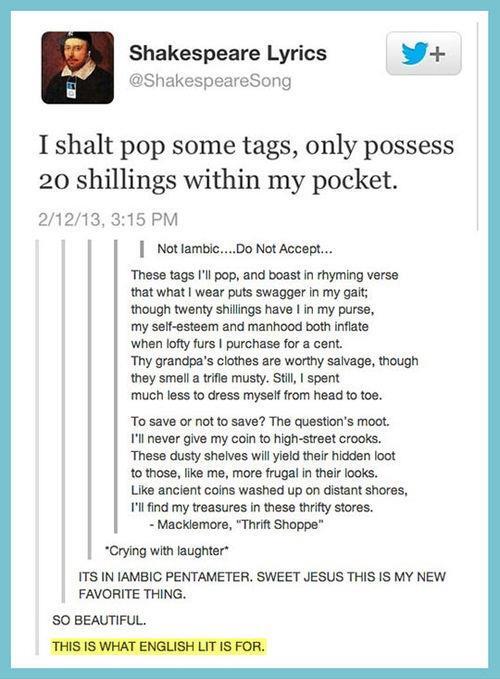
A friend sent me this, unsure if I was familiar with Macklemore but confident that I would appreciate the execution. I gave him the following reply:
This "Macklemore" is scarcely known to me,
and so it is for better or for worse;
that while I can not sing the song to thee,
I'll demonstrate my grasp of older verse.
For songs may come and go with passing days,
and people quote them often for a while
until the point where every music craze
is overdone and triggers rising bile.
So if a song is now a major hit
and every music station gives it play,
it won't be long until we're sick of it
from hearing it nonstop throughout the day.
But when you hear those songs after a while,
nostalgia says, http://tinyurl.com/lezn9fw
Monday, October 7, 2013
Every Time Someone Uses a CBO Forecast, a Dead Puppy Returns to Life
I can always tell at a glance when someone has made a projection based on Congressional Budget Office forecasts, since they always involve a picture of doom and gloom that suddenly explodes into prosperity a couple of years after the line between "historical" and "projected." Dead puppies are projected to come back to life and resume playing, based on historical trends for the amount of time those puppies spent playing before they died and subsequently became not much fun.
The CBO produces economic forecasts for Congress. There are two assumptions in CBO forecasts that make them useless for anyone else, one of which might make them useless for Congress itself.
The first of these assumptions is that the forecasts are made "under current law," which means that they do not account for any new laws and new spending that Congress might make in the meantime. That's not a problem for Congress since they use CBO forecasts to guess at how much money they might be able to spend, but for the rest of us, the CBO forecast provides us with a forecast for a world in which Congress meets to discuss new ways to spend money, but goes home after they can't think of any.
The second of these assumptions is that GDP will return to trend, in other words that we'll be back to potential GDP within a few years. Exactly what potential GDP is involves a whole lot of guessing and some extrapolating of historical GDP growth, but the basic idea is that if you have a crappy economy, it's not a permanent setback and it'll grow faster later to make up for it. The latest CBO forecast assumes that we'll be all caught up by 2017.
In 2008, they assumed better than average historical growth for the years after 2009. From 2010-2013 we averaged 1.95% GDP growth, well below the average historical growth of 3.4%. They also guessed in 2008 that GDP would grow by 2.8% in 2009, when it ended up shrinking by 2.6%.
In 2009, they assumed that we'd be back to trend by 2014. We're about a trillion dollars short and 2014 is three months away. Some of us might need to work a couple of extra weekends.
The point I'm making with all of this is that the CBO has an established record of being overly optimistic in its assumptions that GDP will return to trend. Potential GDP is a function of many things: physical and human capital, technology, institutions both private and public, regulation, and so on. Changes in regulation, such as mandating insurance for full time employees, can affect potential GDP in a permanent way. Low labor force participation means that human capital goes unused. Bad government can turn a crappy economy from a temporary setback into the new normal. While the CBO does try to account for losses in human capital due to people retiring or sitting idle for an extended period, it does not, to the best of my knowledge, account for costs of regulatory compliance or people getting priced out of the labor market to due minimum wage increases or insurance mandates.
Stop using CBO forecasts. The puppy is dead.
The CBO produces economic forecasts for Congress. There are two assumptions in CBO forecasts that make them useless for anyone else, one of which might make them useless for Congress itself.
The first of these assumptions is that the forecasts are made "under current law," which means that they do not account for any new laws and new spending that Congress might make in the meantime. That's not a problem for Congress since they use CBO forecasts to guess at how much money they might be able to spend, but for the rest of us, the CBO forecast provides us with a forecast for a world in which Congress meets to discuss new ways to spend money, but goes home after they can't think of any.
The second of these assumptions is that GDP will return to trend, in other words that we'll be back to potential GDP within a few years. Exactly what potential GDP is involves a whole lot of guessing and some extrapolating of historical GDP growth, but the basic idea is that if you have a crappy economy, it's not a permanent setback and it'll grow faster later to make up for it. The latest CBO forecast assumes that we'll be all caught up by 2017.

In 2008, they assumed better than average historical growth for the years after 2009. From 2010-2013 we averaged 1.95% GDP growth, well below the average historical growth of 3.4%. They also guessed in 2008 that GDP would grow by 2.8% in 2009, when it ended up shrinking by 2.6%.
In 2009, they assumed that we'd be back to trend by 2014. We're about a trillion dollars short and 2014 is three months away. Some of us might need to work a couple of extra weekends.
The point I'm making with all of this is that the CBO has an established record of being overly optimistic in its assumptions that GDP will return to trend. Potential GDP is a function of many things: physical and human capital, technology, institutions both private and public, regulation, and so on. Changes in regulation, such as mandating insurance for full time employees, can affect potential GDP in a permanent way. Low labor force participation means that human capital goes unused. Bad government can turn a crappy economy from a temporary setback into the new normal. While the CBO does try to account for losses in human capital due to people retiring or sitting idle for an extended period, it does not, to the best of my knowledge, account for costs of regulatory compliance or people getting priced out of the labor market to due minimum wage increases or insurance mandates.
Stop using CBO forecasts. The puppy is dead.
Thursday, September 12, 2013
Time to Get Myself on a Watch List, I Guess
This is not a popular opinion, but I really don't care: I think we overreacted to 9/11.
The 9/11 attacks were terrible, but we've let them define us as a country too much for too long. People have a tendency to consider probabilities according to emotional impact rather than statistical likelihood, and we've been treating terrorism like a much bigger threat than it actually is for more than a decade. In 2001, more than five times as many Americans were murdered by other Americans than were killed in the 9/11 attacks. Americans were 186 times as likely to die from cancer in that year, and 235 times as likely to die from heart attacks. We are not allocating our time, money, and attention in anything close to a rational way when it comes to the threats that face us.
Worse, I think that the fear inspired by 9/11 has been exploited for political purposes, with opportunistic politicians expanding the power of the federal government using terrorism as an excuse. The surveillance state that we're seeing today would never have happened without it. The response of the American public to the 9/11 attacks, which was to throw away our liberty in a desperate bid for security, was absolutely shameful.
Individuals did some brave things during that crisis. I'm not downplaying the firefighters and police officers who lost their lives trying to save others, or the passengers who died trying to take back a plane before it could be used as a weapon for terrorists. Those people showed the best in us and reacted the way that I hope we all would. The rest of us largely reacted like panic-stricken children, desperate to give the government whatever it wanted as long as they said it was necessary to keep us safe. The TSA, Guantanamo Bay, domestic spying—all of this has been justified by appeals to 9/11.
I'm sick of it. If America is so strong and proud, we need to stop letting politicians use 9/11 as an excuse to trample the freedoms that define our country in the first place. We need to stop being a bunch of cowards in the face of terrorism and recognize that a society that is so locked down as to be invulnerable to terrorist attacks is a society that's not worth living in. They killed less than 1/100,000 of our population, and everybody just went nuts like it was the end of the world. That's just pathetic.
The 9/11 attacks were terrible, but we've let them define us as a country too much for too long. People have a tendency to consider probabilities according to emotional impact rather than statistical likelihood, and we've been treating terrorism like a much bigger threat than it actually is for more than a decade. In 2001, more than five times as many Americans were murdered by other Americans than were killed in the 9/11 attacks. Americans were 186 times as likely to die from cancer in that year, and 235 times as likely to die from heart attacks. We are not allocating our time, money, and attention in anything close to a rational way when it comes to the threats that face us.
Worse, I think that the fear inspired by 9/11 has been exploited for political purposes, with opportunistic politicians expanding the power of the federal government using terrorism as an excuse. The surveillance state that we're seeing today would never have happened without it. The response of the American public to the 9/11 attacks, which was to throw away our liberty in a desperate bid for security, was absolutely shameful.
Individuals did some brave things during that crisis. I'm not downplaying the firefighters and police officers who lost their lives trying to save others, or the passengers who died trying to take back a plane before it could be used as a weapon for terrorists. Those people showed the best in us and reacted the way that I hope we all would. The rest of us largely reacted like panic-stricken children, desperate to give the government whatever it wanted as long as they said it was necessary to keep us safe. The TSA, Guantanamo Bay, domestic spying—all of this has been justified by appeals to 9/11.
I'm sick of it. If America is so strong and proud, we need to stop letting politicians use 9/11 as an excuse to trample the freedoms that define our country in the first place. We need to stop being a bunch of cowards in the face of terrorism and recognize that a society that is so locked down as to be invulnerable to terrorist attacks is a society that's not worth living in. They killed less than 1/100,000 of our population, and everybody just went nuts like it was the end of the world. That's just pathetic.
Monday, September 2, 2013
Buckets Were Serious Business in Medieval Italy
One of the constants of Medieval Europe was the tension between the
papacy and the Holy Roman Empire, which was not holy, Roman, or an
empire. Sometimes this tension manifested itself in the form of
excommunications going both ways, and other times it manifested as
Italian cities who supported one side or the other going to war over ridiculous things.
I will now summarize this historical event after the manner of the Internet.
Bologna: "I has a bucket."
Modena: "I'm in ur base, takin' ur buckets."
Bologna: "No! They be stealin' mah bucket!"
*Warfare ensues. Thousands die.*
Modena: "All your bucket are belong to us."
I will now summarize this historical event after the manner of the Internet.
Bologna: "I has a bucket."
Modena: "I'm in ur base, takin' ur buckets."
Bologna: "No! They be stealin' mah bucket!"
*Warfare ensues. Thousands die.*
Modena: "All your bucket are belong to us."
Sunday, August 25, 2013
FREE CANDY!
There is a specific point in the human psyche where greed and gullibility intersect. Somebody found it and set up a sign there that says "We have [thing you want] that we can't sell because [contrived reason] and so we're giving them away to people who Like this post on Facebook!"
There is no free stuff. There never was. How did all of these people make it through childhood without finding their way into a van with "FREE CANDY" painted on the side? This is the exact same trick.
Remember, when you click "Like" on something because you were baited into it through greed or crass emotional manipulation, you are depriving an Indian of a job.
There is no free stuff. There never was. How did all of these people make it through childhood without finding their way into a van with "FREE CANDY" painted on the side? This is the exact same trick.
Remember, when you click "Like" on something because you were baited into it through greed or crass emotional manipulation, you are depriving an Indian of a job.
Tuesday, July 30, 2013
In Which I Fix Everything
A while ago I started thinking about how I would go about designing a functional welfare state. As a free market guy I'm not a big fan of a welfare state, but if we accept that we've got to have one we can certainly do it better than what we've got, and fix a bunch of other problems while we're at it. I limited myself to preserving existing institutions in some form, since traditional libertarian shibboleths like abolishing the Federal Reserve in favor of a 100% reserve requirement gold standard or ending all welfare payments immediately don't really address the problems of institutions that we're basically stuck with whether we like it or not. So, if I had the power to reform political institutions but not replace them outright, I would approach the problem with the goal of eliminating the following problems:
I. Unnecessarily complex and divisive tax policy.
II. Obscure individual costs of government programs.
III. Welfare system is wasteful and creates disincentives to work.
IV. Ineffective, unfair monetary policy tools.
I'll discuss each of these in order.
So, first up is the tax system. Taxes cause deadweight loss that increases proportionate to the square of the tax rate. Economists across the political spectrum agree on this, but those who favor higher taxes generally view that the government is just so much better at spending money than the rest of us that it's still a good idea to have high taxes. Deadweight loss is also affected by the price elasticity of supply and price elasticity of demand with smaller deadweight losses suffered when elasticity of supply and demand are relatively low. To maximize revenue for a given deadweight loss, tax rates would be inversely proportionate to price elasticity.
However, actually figuring out price elasticity is very much like shooting in the dark at a moving target. Nobody really knows what the demand curve for anything actually looks like since consumer preferences are only made known through purchases at a given price point, and changing the price of a good to get another price point only gives us one more point with which to construct a curve that is by no means a straight line. Furthermore, the greater the time disparity between the collection of purchase data at different price points, the more likely it is that consumer preferences have changed in the meantime. Consumers also take note of frequent changes in price, and this affects their purchasing behavior. As a practical matter, actually constructing an accurate demand curve is a pipe dream.
Companies hire economists to try to figure this stuff out anyway, since taking an educated guess is a bit better than nothing, but if we were to try to base tax policy on it, we would introduce a lot of inefficiency-inducing political pressures at every point where a judgment call is necessary, and the accuracy of the results would be even worse. It would also run counter to the goal of avoiding unnecessary complexity in tax policy.
So, what I would do is replace all current taxes (income tax, payroll taxes, corporate income tax, etc) with a Value Added Tax. It's basically a sales tax that is collected at each stage of production instead of just at the end. To eliminate the possibility of carousel fraud and not distort relative prices of imports and domestically produced goods, the VAT would also apply to the value of imports. The IRS would perform a function similar to the UK's HM Revenue and Customs, although there would be no exceptions or variable VAT rates for different goods. This would minimize the potential for abuse and inefficiencies induced by political pressure, as well as prevent nonsense like the case of Jaffa Cakes being a cake or a biscuit for tax purposes.
Aside from reducing compliance costs with taxation, a VAT would give everyone a stake in government spending. There is a very strong tendency in a representative system of government to try to make other people pay for things that benefit you. As a general rule of thumb, politicians respond to people according to their political significance. Swing voters (and in presidential elections, swing states) get subsidies and lots of political attention, while voters whose vote is a foregone conclusion will be exploited for all they're worth by politicians on the other side. Non-voters are a source of revenue at best, but there is no political capital to be gained by doing anything for them.
The complexity of the tax system means that any individual's actual share of the tax burden is extremely difficult to figure out. A good example of this is the payroll tax, which is supposedly paid 50% by the employer and 50% by the employee, but in practice the actual burden of the tax shifts according to the relative elasticity of supply and demand for labor. Remember when I talked about how hard it is to plot out an accurate demand curve earlier? You'd need to be able to do this to determine what your actual share of the payroll tax burden is, as well as every other tax on any transaction you are involved with. Good luck!
Once you've assembled a team of specialists including (at minimum) a tax accountant, an economist, and a wizard (to verify the accuracy of the economist's assumptions), you could look at the share of the budget that each government program comprises, and from there you could calculate how much a particular program cost you personally that year.
However, under a VAT this would be simplified somewhat. While people would still try to vote themselves disproportionate benefits out of the public treasury, under a VAT they at least wouldn't be able to use political influence to excuse themselves from taxation and push the costs of government programs onto others, which brings me to the next problem to fix: obscure costs of government programs.
With a VAT, the tax burden is quite a lot easier to figure out. You wouldn't even need to know what your income is; you'd just need to know what the VAT rate is, which is about as hard as knowing your local sales tax rate. As an example, the cost of Medicare, Medicaid, and Social Security together comprise about 40% of the federal budget. Under a VAT with a tax rate of 30%, you could say that the cost of those programs was 12 cents on the dollar, for everybody.
Having the cost of government programs framed in such a way makes them comprehensible to everyone. I've got a strong suspicion that on some level, voters think that a billion is about ten million, and a trillion is about ten billion. The human brain sucks at actually comprehending large numbers.
A good demonstration of this was the Occupy Wall Street protests. A poll showed that 94% believed that the government spent more on the military than it did on education or healthcare and pensions. In reality, the government spends more than twice as much on healthcare and pensions as it does on the military. While it's tempting to say that liberal protesters are just particularly awful with large numbers, I think that ignorance of the costs of government is probably a little more widespread than that.
Making it so that the cost of government programs is easily comprehensible to the average voter can only improve political outcomes. At the very least, the political discourse would be a little harder to overwhelm with misinformation, and a VAT would make it harder to divide voters on tax issues by pushing the costs onto some other group.
This is one of those issues that suffers disproportionately from the difficulty in calculating individual tax burden. How much does a given person pay in taxes for welfare? How much does a household below the poverty line actually collect in benefits? The amount of money going into the system compared to the amount of money going out in benefits would give us a good idea of how much money is being lost to administrative costs or government waste.
Last year, the Senate Budget Committee found that combined state and federal welfare spending combined amounted to about $60,000 per household below the poverty line. This isn't to say that every household below the poverty line collected this much in benefits; some of these benefits accrue to households above the poverty line. But still, that's 20% higher than the median household income in the United States, so what gives?
Well, that figure includes Social Security, which accounts for an awful lot. There are also administrative costs for each of the wide variety of programs aimed at poverty. There are subsidized housing programs, food stamps, medicare/medicaid, and so on. The total cost of welfare spending is another one of those things that most people remain oblivious to. To the Left it's not enough and to the Right it's too much, but despite how often people bicker about this it's pretty rare for anyone to actually bring up hard numbers and break down where they all come from. To make matters worse, poverty statistics in the United States are based on income, but do not include government programs in that figure. A family of four with a cash income of $20,000 per year (which is below the poverty line of $23,550 for that family in 2013) and government benefits totaling an additional $30,000 would be living on median income, but would still count as impoverished just because we don't count the government benefits that account for 60% of their income.
I did some thinking about how I would design a social safety net that minimizes administrative costs and does not produce disincentives to work for those at the low end of the income spectrum. The current system has benefits that phase out in stages as income increases, so additional income is partially offset by decreasing benefits. It's also split into countless different programs. Nobody pays taxes on welfare benefits, which makes for a fundamental divide between those who collect benefits and those who pay taxes. From the perspective of the zero-income welfare recipient, they don't care what tax rates are required for a particular government program because their share of it is zero. Their cost-benefit analysis doesn't include costs, and they will consistently advocate greater spending on anything that they like.
What I would do is replace the entire array of social welfare spending (including social security, medicare, food stamps, subsidized housing, etc) with a universal basic income. It's the simplest possible solution: give every adult citizen a regular payment. When combined with a VAT, this would mean that there is a social safety net, but also that everyone would have a stake in the cost of government. It would also resolve one of the major objections to replacing the income tax with a consumption tax like a sales tax or a VAT, specifically the non-progressive nature of those forms of taxation. Some people really like the idea that a person with more income pays a higher percentage of their income, and oppose consumption taxes on the basis that they are not progressive. They occasionally claim that sales taxes are regressive, but I think it's just beyond stupid for anyone to make such a claim. Everyone facing the same tax rate is by definition neither regressive nor progressive.
Milton Friedman supported a negative income tax; he supported subsidies for people making less than a set amount, and taxes paid on income above that amount. That system still features a skewed cost-benefit analysis for people making less than the tax free amount, since they don't face any of the costs of any program that they support. Otherwise, there are similarities.
Here are some sample incomes to show what this would look like for various income levels with a VAT of 50% (meaning that 33% of the total cost is in taxes) and a universal basic income of $15,000. The break even point using these values is $30,000, where a person making less than this effectively gets a subsidy and a person making more than this is paying more than they are getting.
Income of $0 plus $15k minus 33% = $10,000 ($10,000 subsidy)
Income of $15k plus $15k minus 33% = $20,000 ($5,000 subsidy)
Income of $30k plus $15k minus 33% = $30,000 (No subsidy)
Income of $45k plus $15k minus 33% = $40,000 ($5,000 tax burden)
Income of $60k plus $15k minus 33% = $50,000 ($10,000 tax burden)
As income increases, the real tax rate approaches 33%. Higher tax rates or lower payouts push the break-even point lower. A VAT combined with a universal basic income ends up producing a progressive tax system without actually charging anyone different rates or granting exemptions. It gives everyone a stake in government spending, clarifies the cost of government, simplifies the tax code, and removes one of the most divisive tendencies in representative systems of government. Not only that, but it provides a perfect framework to reform our banking system, in particular the role of the central bank.
Here is an overview of monetary policy tools available to the Federal Reserve. The biggest one is open market operations, which is sort of like a steering wheel that is connected to a few different cars at once. They try to influence the Fed funds rate and the monetary base using the same tool. If they want to influence one but not the other, that's not possible. If they want to increase the availability of funds to the public as a macroeconomic policy move, they use open market operations to expand the monetary base, making those funds available to banks who then lend money to the public.
There are two problems evident with this. The first is that it's unfair. Increasing the money supply diminishes the real value of debt, so there is a transfer of wealth from creditors to debtors. The devaluation of dollar-denominated assets such as savings accounts is what most people talk about when they complain about how unfair inflation is. However, if the change in the money supply is anticipated, it will be reflected in interest rates to account for this. Half of the Federal Reserve's job is just bluffing banks into doing what the Fed wants them to do.
That's not the really unfair part, though. If the increase in the money supply is known well enough in advance that interest rates can account for it, then it's a wash. The really unfair part is related to the distorting effects of monetary injections. When the money supply expands, prices rise, but they don't all rise at the same time. The people who get the new money first get to spend it before prices rise, and as that money circulates through the economy other prices rise as the new money reaches them. The Federal Reserve expands the money supply through commercial banks, meaning they consistently get the money before anybody else. This gives banks an opportunity to buy assets secure in the knowledge that they are paying a lower price than they'd have to pay for those same assets after their money has had a chance to slosh around the economy for a bit.
The ineffective part is something we've been seeing recently. If you're trying to add money to the economy through commercial banks, that's rather contingent upon the banks actually lending that money out instead of sitting on it. Which is exactly what they've been doing. The less money that banks lend, the more desperate the Fed is to give them money in the hope that they will lend it out. I think banks have caught on to this, and now have nearly two trillion dollars in excess reserves while the Fed scrambles to do anything it can to throw more money at them.
Coincidentally, if banks are holding more than the Fed's reserve requirement, then changes in the reserve requirements become entirely useless as a means of enacting macroeconomic policy unless you raise the requirements high enough that banks have to cut back on lending even with the extra money they were already sitting on. Lowering the reserve requirement won't have any effect no matter if banks don't do any extra lending with the extra slack you've given them. It's like pushing a rope.
So, what would I do to fix this? I would use the universal basic income as the outlet for monetary creation. The Fed would still retain control over monetary policy to distance it from political pressures to increase the payout, but changes in the money supply would come in the form of changes in the universal basic income. It's a blending of monetary policy and fiscal policy, but as long as the decision is made by the central bank rather than politicians, it's more insulated from the political pressures that produced awful monetary policy back when monetary authority was vested in Congress.
Rather than having interest rates derived from the fed funds target rate which is aimed at through open market operations, interest rates would be derived from the supply and demand for loanable funds, which is inherently counter-cyclical. In any case, it'd be a lot more reliable than just throwing money at the economy while eyeballing the Consumer Price Index in the hope that it'll tell them when they're doing too much.
I. Unnecessarily complex and divisive tax policy.
II. Obscure individual costs of government programs.
III. Welfare system is wasteful and creates disincentives to work.
IV. Ineffective, unfair monetary policy tools.
I'll discuss each of these in order.
Unnecessarily Complex and Divisive Tax Policy
So, first up is the tax system. Taxes cause deadweight loss that increases proportionate to the square of the tax rate. Economists across the political spectrum agree on this, but those who favor higher taxes generally view that the government is just so much better at spending money than the rest of us that it's still a good idea to have high taxes. Deadweight loss is also affected by the price elasticity of supply and price elasticity of demand with smaller deadweight losses suffered when elasticity of supply and demand are relatively low. To maximize revenue for a given deadweight loss, tax rates would be inversely proportionate to price elasticity.
However, actually figuring out price elasticity is very much like shooting in the dark at a moving target. Nobody really knows what the demand curve for anything actually looks like since consumer preferences are only made known through purchases at a given price point, and changing the price of a good to get another price point only gives us one more point with which to construct a curve that is by no means a straight line. Furthermore, the greater the time disparity between the collection of purchase data at different price points, the more likely it is that consumer preferences have changed in the meantime. Consumers also take note of frequent changes in price, and this affects their purchasing behavior. As a practical matter, actually constructing an accurate demand curve is a pipe dream.
Companies hire economists to try to figure this stuff out anyway, since taking an educated guess is a bit better than nothing, but if we were to try to base tax policy on it, we would introduce a lot of inefficiency-inducing political pressures at every point where a judgment call is necessary, and the accuracy of the results would be even worse. It would also run counter to the goal of avoiding unnecessary complexity in tax policy.
So, what I would do is replace all current taxes (income tax, payroll taxes, corporate income tax, etc) with a Value Added Tax. It's basically a sales tax that is collected at each stage of production instead of just at the end. To eliminate the possibility of carousel fraud and not distort relative prices of imports and domestically produced goods, the VAT would also apply to the value of imports. The IRS would perform a function similar to the UK's HM Revenue and Customs, although there would be no exceptions or variable VAT rates for different goods. This would minimize the potential for abuse and inefficiencies induced by political pressure, as well as prevent nonsense like the case of Jaffa Cakes being a cake or a biscuit for tax purposes.
Aside from reducing compliance costs with taxation, a VAT would give everyone a stake in government spending. There is a very strong tendency in a representative system of government to try to make other people pay for things that benefit you. As a general rule of thumb, politicians respond to people according to their political significance. Swing voters (and in presidential elections, swing states) get subsidies and lots of political attention, while voters whose vote is a foregone conclusion will be exploited for all they're worth by politicians on the other side. Non-voters are a source of revenue at best, but there is no political capital to be gained by doing anything for them.
The complexity of the tax system means that any individual's actual share of the tax burden is extremely difficult to figure out. A good example of this is the payroll tax, which is supposedly paid 50% by the employer and 50% by the employee, but in practice the actual burden of the tax shifts according to the relative elasticity of supply and demand for labor. Remember when I talked about how hard it is to plot out an accurate demand curve earlier? You'd need to be able to do this to determine what your actual share of the payroll tax burden is, as well as every other tax on any transaction you are involved with. Good luck!
Once you've assembled a team of specialists including (at minimum) a tax accountant, an economist, and a wizard (to verify the accuracy of the economist's assumptions), you could look at the share of the budget that each government program comprises, and from there you could calculate how much a particular program cost you personally that year.
However, under a VAT this would be simplified somewhat. While people would still try to vote themselves disproportionate benefits out of the public treasury, under a VAT they at least wouldn't be able to use political influence to excuse themselves from taxation and push the costs of government programs onto others, which brings me to the next problem to fix: obscure costs of government programs.
Obscure Individual Costs of Government Programs
With a VAT, the tax burden is quite a lot easier to figure out. You wouldn't even need to know what your income is; you'd just need to know what the VAT rate is, which is about as hard as knowing your local sales tax rate. As an example, the cost of Medicare, Medicaid, and Social Security together comprise about 40% of the federal budget. Under a VAT with a tax rate of 30%, you could say that the cost of those programs was 12 cents on the dollar, for everybody.
Having the cost of government programs framed in such a way makes them comprehensible to everyone. I've got a strong suspicion that on some level, voters think that a billion is about ten million, and a trillion is about ten billion. The human brain sucks at actually comprehending large numbers.
A good demonstration of this was the Occupy Wall Street protests. A poll showed that 94% believed that the government spent more on the military than it did on education or healthcare and pensions. In reality, the government spends more than twice as much on healthcare and pensions as it does on the military. While it's tempting to say that liberal protesters are just particularly awful with large numbers, I think that ignorance of the costs of government is probably a little more widespread than that.
Making it so that the cost of government programs is easily comprehensible to the average voter can only improve political outcomes. At the very least, the political discourse would be a little harder to overwhelm with misinformation, and a VAT would make it harder to divide voters on tax issues by pushing the costs onto some other group.
Welfare System is Wasteful and Creates Disincentives to Work
This is one of those issues that suffers disproportionately from the difficulty in calculating individual tax burden. How much does a given person pay in taxes for welfare? How much does a household below the poverty line actually collect in benefits? The amount of money going into the system compared to the amount of money going out in benefits would give us a good idea of how much money is being lost to administrative costs or government waste.
Last year, the Senate Budget Committee found that combined state and federal welfare spending combined amounted to about $60,000 per household below the poverty line. This isn't to say that every household below the poverty line collected this much in benefits; some of these benefits accrue to households above the poverty line. But still, that's 20% higher than the median household income in the United States, so what gives?
Well, that figure includes Social Security, which accounts for an awful lot. There are also administrative costs for each of the wide variety of programs aimed at poverty. There are subsidized housing programs, food stamps, medicare/medicaid, and so on. The total cost of welfare spending is another one of those things that most people remain oblivious to. To the Left it's not enough and to the Right it's too much, but despite how often people bicker about this it's pretty rare for anyone to actually bring up hard numbers and break down where they all come from. To make matters worse, poverty statistics in the United States are based on income, but do not include government programs in that figure. A family of four with a cash income of $20,000 per year (which is below the poverty line of $23,550 for that family in 2013) and government benefits totaling an additional $30,000 would be living on median income, but would still count as impoverished just because we don't count the government benefits that account for 60% of their income.
I did some thinking about how I would design a social safety net that minimizes administrative costs and does not produce disincentives to work for those at the low end of the income spectrum. The current system has benefits that phase out in stages as income increases, so additional income is partially offset by decreasing benefits. It's also split into countless different programs. Nobody pays taxes on welfare benefits, which makes for a fundamental divide between those who collect benefits and those who pay taxes. From the perspective of the zero-income welfare recipient, they don't care what tax rates are required for a particular government program because their share of it is zero. Their cost-benefit analysis doesn't include costs, and they will consistently advocate greater spending on anything that they like.
What I would do is replace the entire array of social welfare spending (including social security, medicare, food stamps, subsidized housing, etc) with a universal basic income. It's the simplest possible solution: give every adult citizen a regular payment. When combined with a VAT, this would mean that there is a social safety net, but also that everyone would have a stake in the cost of government. It would also resolve one of the major objections to replacing the income tax with a consumption tax like a sales tax or a VAT, specifically the non-progressive nature of those forms of taxation. Some people really like the idea that a person with more income pays a higher percentage of their income, and oppose consumption taxes on the basis that they are not progressive. They occasionally claim that sales taxes are regressive, but I think it's just beyond stupid for anyone to make such a claim. Everyone facing the same tax rate is by definition neither regressive nor progressive.
Milton Friedman supported a negative income tax; he supported subsidies for people making less than a set amount, and taxes paid on income above that amount. That system still features a skewed cost-benefit analysis for people making less than the tax free amount, since they don't face any of the costs of any program that they support. Otherwise, there are similarities.
Here are some sample incomes to show what this would look like for various income levels with a VAT of 50% (meaning that 33% of the total cost is in taxes) and a universal basic income of $15,000. The break even point using these values is $30,000, where a person making less than this effectively gets a subsidy and a person making more than this is paying more than they are getting.
Income of $0 plus $15k minus 33% = $10,000 ($10,000 subsidy)
Income of $15k plus $15k minus 33% = $20,000 ($5,000 subsidy)
Income of $30k plus $15k minus 33% = $30,000 (No subsidy)
Income of $45k plus $15k minus 33% = $40,000 ($5,000 tax burden)
Income of $60k plus $15k minus 33% = $50,000 ($10,000 tax burden)
As income increases, the real tax rate approaches 33%. Higher tax rates or lower payouts push the break-even point lower. A VAT combined with a universal basic income ends up producing a progressive tax system without actually charging anyone different rates or granting exemptions. It gives everyone a stake in government spending, clarifies the cost of government, simplifies the tax code, and removes one of the most divisive tendencies in representative systems of government. Not only that, but it provides a perfect framework to reform our banking system, in particular the role of the central bank.
Ineffective, Unfair Monetary Policy Tools
Here is an overview of monetary policy tools available to the Federal Reserve. The biggest one is open market operations, which is sort of like a steering wheel that is connected to a few different cars at once. They try to influence the Fed funds rate and the monetary base using the same tool. If they want to influence one but not the other, that's not possible. If they want to increase the availability of funds to the public as a macroeconomic policy move, they use open market operations to expand the monetary base, making those funds available to banks who then lend money to the public.
There are two problems evident with this. The first is that it's unfair. Increasing the money supply diminishes the real value of debt, so there is a transfer of wealth from creditors to debtors. The devaluation of dollar-denominated assets such as savings accounts is what most people talk about when they complain about how unfair inflation is. However, if the change in the money supply is anticipated, it will be reflected in interest rates to account for this. Half of the Federal Reserve's job is just bluffing banks into doing what the Fed wants them to do.
That's not the really unfair part, though. If the increase in the money supply is known well enough in advance that interest rates can account for it, then it's a wash. The really unfair part is related to the distorting effects of monetary injections. When the money supply expands, prices rise, but they don't all rise at the same time. The people who get the new money first get to spend it before prices rise, and as that money circulates through the economy other prices rise as the new money reaches them. The Federal Reserve expands the money supply through commercial banks, meaning they consistently get the money before anybody else. This gives banks an opportunity to buy assets secure in the knowledge that they are paying a lower price than they'd have to pay for those same assets after their money has had a chance to slosh around the economy for a bit.
The ineffective part is something we've been seeing recently. If you're trying to add money to the economy through commercial banks, that's rather contingent upon the banks actually lending that money out instead of sitting on it. Which is exactly what they've been doing. The less money that banks lend, the more desperate the Fed is to give them money in the hope that they will lend it out. I think banks have caught on to this, and now have nearly two trillion dollars in excess reserves while the Fed scrambles to do anything it can to throw more money at them.
Coincidentally, if banks are holding more than the Fed's reserve requirement, then changes in the reserve requirements become entirely useless as a means of enacting macroeconomic policy unless you raise the requirements high enough that banks have to cut back on lending even with the extra money they were already sitting on. Lowering the reserve requirement won't have any effect no matter if banks don't do any extra lending with the extra slack you've given them. It's like pushing a rope.
So, what would I do to fix this? I would use the universal basic income as the outlet for monetary creation. The Fed would still retain control over monetary policy to distance it from political pressures to increase the payout, but changes in the money supply would come in the form of changes in the universal basic income. It's a blending of monetary policy and fiscal policy, but as long as the decision is made by the central bank rather than politicians, it's more insulated from the political pressures that produced awful monetary policy back when monetary authority was vested in Congress.
Rather than having interest rates derived from the fed funds target rate which is aimed at through open market operations, interest rates would be derived from the supply and demand for loanable funds, which is inherently counter-cyclical. In any case, it'd be a lot more reliable than just throwing money at the economy while eyeballing the Consumer Price Index in the hope that it'll tell them when they're doing too much.
Tuesday, June 18, 2013
Why Aren't I Married?
I find myself considering the reason why I am not married. Is it because of a shortage of common interests? Poor social skills? My complete lack of effort? Are my unreasonably high expectations to blame? Or is it Cotton-eye Joe? There is, perhaps, some merit to all of these reasons. Any one of them could be sufficient to explain why I didn't get married a long time ago.
But there is yet another reason to consider: I heard a legend on the Internet that if you stay a virgin until you're 30, you become a wizard! So I played hard to want. Now I'm 31, and you can imagine my surprise.
Don't tell the Muggles though; they're not supposed to know.
But there is yet another reason to consider: I heard a legend on the Internet that if you stay a virgin until you're 30, you become a wizard! So I played hard to want. Now I'm 31, and you can imagine my surprise.
Don't tell the Muggles though; they're not supposed to know.
A Libertarian Against Bad Arguments Against Obama

I've seen this image floating around Facebook, and it bothers me. Not because it paints Obama in a bad light, but because it uses bad arguments to do it. When you make an argument, people assume that's the best you've got, so something like this is counterproductive if you want to make Obama look bad. The facts are more than enough to do that, so I'll be fact checking and correcting this. A lot of this data is, at best, a couple of years out of date. Some of it is the wrong data to use to make the point in the first place, and I also don't care for including early 2009 as part of "Obama's economic record" simply because we wouldn't have enough time for his policies to take effect in any case. In short, this graphic paints a picture of decline, when the reality is not decline, but rather stagnation and mediocrity.
Unemployed Americans
The first thing on the list is the number of unemployed Americans. We started with about 12.2 million, and today we're down to about 11.7 million. We passed 14 million in the first half of 2009, and dropped below 14 million around the beginning of 2011. We were down to about 11.7 million as of May 2013. Before the crash, we were at about 7 million. I'll provide data starting in 2007 for context's sake.
Number of Unemployed, January 2007 through May 2013

This looks like an improvement, but it's important to remember that people who give up on looking for work are no longer counted as unemployed. The other problem with this is that it uses absolute numbers, rather than a percentage of the total population. Our population is growing, so we could have more unemployed people even if the unemployment rate is going down, so the comparison is going to be inaccurate simply due to changes in the size of the population. The most charitable interpretation of this data is simply that they are using statistics from 2009-2011, which covers less than half of Obama's presidency. Time to update your data, guys.
Unemployment Rate
Next up we've got the unemployment rate. Starting at 7.8% and going to 9.1%, it's looking more like the original graphic is was made using data from early 2011. The unemployment rate was 7.6% as of May 2013.
Unemployment Rate, January 2007 through May 2013

This is a better statistic to use than simply the number of unemployed since it accounts for changes in population, but even within the limited time frame covered it does not account for people who gave up on looking for work. There are substantial numbers of these people, so the unemployment rate is going to understate the magnitude of the problem. What we should be looking at is the civilian employment to population ratio, which is just a ratio between the number of working age Americans and the number of Americans who have jobs.
Civilian Employment to Population Ratio, January 2007 through May 2013

As you can see, this started around 63% in 2007 and tanked to about 58.5% between 2008 and 2010, and it's been stuck there ever since. I think that this data gives us the most accurate picture of the employment situation. It's not getting better, but it's not getting worse; crappy is the new normal. Naturally, the Democrats ignore this one in favor of the unemployment rate (which goes down as people give up) and the Republicans play games by counting "underemployed" workers and adding those totals to the unemployed and discouraged workers to get made up but impressive sounding metrics like the "Real Unemployment Rate," which ironically is not a real metric tracked by economists in general.
Gas Prices
Since when is the price of gas the President's responsibility? It makes no sense to include the price of gas as part of Obama's economic record, because oil is a commodity. It is fungible. It is globally traded, and we buy most of ours from other countries. While Obama's environmental policies on oil development in the United States do have an impact, the price of oil is only influenced by this to the extent that US production affects the global supply. The impact of US oil development on gas prices when compared to the influence of global market conditions is basically irrelevant. Policies like mandatory ethanol additives also have an impact, but again it makes no sense to try to judge Obama by the price of a gallon of gas when most of that is completely beyond his responsibility or ability to control. If he did increase US production, OPEC could just cut back theirs to maintain the current price.
Federal Debt
To start with, the nominal amount of the debt doesn't matter; what matters is how large the debt is as a percentage of GDP. It's been on the rise in a huge way, but this started in earnest back in 2007 when the Democrats took control of Congress, not when Obama took office. That makes it harder to pin the blame on Obama, but the reality is that Bush was extremely fiscally irresponsible as well. Obama has basically just doubled down on Bush's bad fiscal policies.
However, going from $10.6 trillion to $14.7 trillion lets us look at the exact time frame used for this data. We hit $10.6 trillion in Q4 of 2008 and $14.7 around Q3 of 2011. This one looks to be intellectually dishonest instead of just outdated, since it's counting from several months before Obama took office. The fact that it includes data from the latter half of 2011 when the previous data about unemployment stops at the beginning of 2011 makes it look like data is being cherry picked to make it look more impressive. Do not do this. There is a circle in Economist Hell specifically for people who cherry pick data.
This is infuriating, because they are doing something intellectually dishonest and thereby discrediting their own position when the truth is more than sufficient to make the point. The St. Louis Fed only has data available through January of 2013, so the data series ends there.
Federal Debt, Total Public Debt, January 2007 through January 2013

The federal debt has increased significantly in the last six years, going from $8.8 trillion to $16.8 trillion. When Obama took office it was about $11.2 trillion. But, like I said before, we should be looking at the debt as a percentage of GDP, because that reflects our ability to pay it off. First we get some historical perspective and then look a little closer, comparing Bush and Obama.
Federal Debt, Total Public Debt as a Percentage of GDP, January 1966 through January 2013

Federal Debt, Total Public Debt as a Percentage of GDP, January 2001 through January 2013

If we look back a little further using data from the Congressional Budget Office, we can see that the federal debt as a percentage of GDP peaked at about 112% in 1945. WW2 was expensive and was financed largely through war bonds. This debt dropped off quickly, and was down to less than 50% of GDP by 1960, and reached about 25% by the mid 1970s.
When the Republicans held Congress for six years between 2001 and 2007, the debt increased by less than 8%. When the Democrats took the House and Senate in 2007, over the next two years the debt increased by 15%. Obama took office in 2009, and over the two years that followed the debt increased by another 16%. In the last two years from 2011 to 2013, the debt has increased by another 9%. We're currently looking at a debt to GDP ratio of about 105%, and we're rapidly approaching our previous WW2 high.
While it is true that deficits are larger during recessions (the latest of which officially ended in 2009, by the way), we can look at past recessions for comparison. The Great Depression was a lot worse than the more recent housing crash and financial crisis, and when combined with the New Deal it added to the debt by about 30% of GDP. That is how the Republicans should be explaining the debt situation, not making intellectually dishonest comparisons between late 2008 and mid 2011.
Debt Per Person
When you are looking at a single point in time, this can help people get their minds around the very large number that is the national debt. It doesn't work well for comparisons to a past point in time, because it doesn't count inflation, which makes the difference appear larger than it really is. Debt as a percentage of GDP covers this. The decision to use debt per person rather than debt as a percentage of GDP is a misleading gimmick.
Misery Index
How many people even know what the Misery Index is? It's the unemployment rate (which has problems, as I've discussed) plus the inflation rate, with both of them evenly weighted. There's not much point to citing this to people who don't know what it is, but it sounds bad, so that's why it gets a spot. The inflation rate is largely the Federal Reserve's responsibility anyway; the government controls fiscal policy, while the Fed handles monetary policy. If you're going to blame somebody for the inflation rate, blame Ben Bernanke. He was appointed as chairman of the Fed by Bush and then renominated by Obama. His performance in that capacity is exactly as everyone predicted: throw money at the economy until the unemployment rate goes down.
Food Stamp Recipients
Finally, something that doesn't look blatantly wrong. I had to actually look up the data myself to find out that yes, this is more intellectually dishonest BS. The Census showed 32,889,000 people on food stamps (SNAP) in January 2009, which the graphic reports as 32 million. Guys, you can't just truncate remainders like this. Either report the more accurate fraction of a million or at the very least round it to the nearest integer; don't just truncate 32.9 down to 32 to make it look worse than it is. The 45 million on food stamps is accurate for mid 2011. We're up to about 47.7 million by now, according to SNAP themselves. Again, the main point that they are trying to get across is solid, but they undermine their own position by intellectual dishonesty when there really isn't any point in doing so.
Health Insurance Premiums
Like with gas prices, this isn't the President's job. The President does not set the price of insurance policies. While requiring people to buy insurance will cause an increase in the cost of insurance, all other things being equal, that does not mean that the price of insurance in early 2009 should be directly compared to whenever it was that they found this other number.
Home Values
This is more stuff that isn't the President's job. Trying to get everybody into a house whether they could afford one or not is what got us into this mess in the first place. Lower prices are good for home buyers, and higher prices are good for home sellers. Saying that a shift in prices is universally good or bad is just stupid.
US Global Competitiveness
There are a lot of different measures for this sort of thing. Why choose this one? Why not the Index of Economic Freedom, or the Economic Freedom of the World report? The Economic Freedom of the World report shows the US dropping from 2nd place to 8th place between 2000 and 2005, and down to 18th place by 2010.
While this is not intellectually dishonest per se, it's still a weak argument because one could just as easily pick a different report to get rankings that favor their argument. There is no "gold standard" for this sort of thing; multiple rankings exist, and they are all calculated differently.
Americans in Poverty
Comparing poverty statistics is another thing that bothers me, because the definition of poverty changes over time, and there are often multiple definitions in use at once. Are these absolute poverty statistics, or measures of relative expenditure? Sometimes poverty is three times the cost of a nutritionally adequate diet, and other times it is simply an arbitrarily selected percentage of the median income. Some measures of poverty include government transfer payments (food stamps, welfare, etc) and others do not. If you're going to talk about poverty, you need to devote some space to explaining what exactly you are saying, rather than just throwing out numbers like this.
Conclusion
None of this stuff is sourced or dated, and all of the dates I found were done by just backtracking into various time series to figure out when the data would have been accurate, and that could be wrong if the numbers in the graphic were being stretched in the first place. The information that isn't outdated is either exaggerated by the way it is presented, or irrelevant. Obama's poor showing is better criticized by not resorting to intellectually dishonest tactics; the truth about the debt, the dramatically increasing numbers of people on government support, and the poor employment to population ratio is more than enough to condemn him.
Sunday, May 19, 2013
Theology in the Style of Gilbert and Sullivan
There are two groups of people, diametrically opposed, who are remarkably similar to one another in a number of ways, including their capacity to annoy me. These groups are theists who claim moral superiority solely on the basis of their belief, and atheists who claim intellectual superiority solely on the basis of their non-belief.
Society has done a pretty good job of beating down the first group, to the point where their most visible representatives are 40 idiots in Kansas. There is no end to the publicity that these people receive, even though they are so few in number that two short buses could carry all of them at once.
On the other hand, we have the evangelical atheists. Since you're reading this online and the Internet is their natural habitat, I'm sure you've come across at least a few of these people. They're the ones who declare, full of faith in their own superiority, that religious people are stupid. They'll post updates on the latest antics of the aforementioned 40 idiots in Kansas, trying to smear all theists with the actions of just a few. They'll compare the Spanish Inquisition to the Holocaust, even though the Spanish Inquisition killed maybe 5,000 people over the course of 260 years (meaning they executed fewer people on average than the Texas criminal justice system has over the past few decades) while the Nazis killed around ten million in six years if you count Soviet prisoners of war. They'll claim that all wars are caused by religion, conveniently omitting both world wars and the handful of Chinese dynastic civil wars that get basically no attention in the English speaking world but several of which had death tolls above ten million. None of those matter, because to them, all warfare stems from religious belief, and if you believe in God then you are both stupid and culpable for whatever evil they feel like attributing to religion today. It is not enough for them not to believe; you shouldn't believe either, and they proselytize aggressively.
Inspired by the faithful missionaries from the church of non-belief, I wrote some lyrics for the Major-General's Song from Gilbert and Sullivan's The Pirates of Penzance:
Society has done a pretty good job of beating down the first group, to the point where their most visible representatives are 40 idiots in Kansas. There is no end to the publicity that these people receive, even though they are so few in number that two short buses could carry all of them at once.
On the other hand, we have the evangelical atheists. Since you're reading this online and the Internet is their natural habitat, I'm sure you've come across at least a few of these people. They're the ones who declare, full of faith in their own superiority, that religious people are stupid. They'll post updates on the latest antics of the aforementioned 40 idiots in Kansas, trying to smear all theists with the actions of just a few. They'll compare the Spanish Inquisition to the Holocaust, even though the Spanish Inquisition killed maybe 5,000 people over the course of 260 years (meaning they executed fewer people on average than the Texas criminal justice system has over the past few decades) while the Nazis killed around ten million in six years if you count Soviet prisoners of war. They'll claim that all wars are caused by religion, conveniently omitting both world wars and the handful of Chinese dynastic civil wars that get basically no attention in the English speaking world but several of which had death tolls above ten million. None of those matter, because to them, all warfare stems from religious belief, and if you believe in God then you are both stupid and culpable for whatever evil they feel like attributing to religion today. It is not enough for them not to believe; you shouldn't believe either, and they proselytize aggressively.
Inspired by the faithful missionaries from the church of non-belief, I wrote some lyrics for the Major-General's Song from Gilbert and Sullivan's The Pirates of Penzance:
He is the very model of a modern cyber atheist
Who claims he's packing logic but is just another dogmatist
Claiming that something's missing from the infinite expanse of space
Requires understanding that we simply don't have of the place
He's making claims while lacking any scientific evidence
Just like the fundamentalist who claims all things are providence
Now if you're an agnostic I would say that's justifiable
Consistent with just making claims from evidence available
Now I would count myself among those logical agnostic guys
If I had not had some experience showing contrariwise
If I ignored that evidence I'd be a crappy scientist
Just like the very model of a modern cyber atheist
Who claims he's packing logic but is just another dogmatist
Claiming that something's missing from the infinite expanse of space
Requires understanding that we simply don't have of the place
He's making claims while lacking any scientific evidence
Just like the fundamentalist who claims all things are providence
Now if you're an agnostic I would say that's justifiable
Consistent with just making claims from evidence available
Now I would count myself among those logical agnostic guys
If I had not had some experience showing contrariwise
If I ignored that evidence I'd be a crappy scientist
Just like the very model of a modern cyber atheist
Monday, May 6, 2013
Poetry Dump
One of my favorite verse forms is the double dactyl, sometimes called a "higgledy piggledy." It's got a rather long list of rules and follows a rigid meter, but it's very satisfying to write one because it's so challenging. Incidentally, the strict rules regarding what content goes in each line combined with the meter makes a double dactyl very easy to memorize. Here are a few of them that I have written, which are being posted again as cultural icons for posterity to cherish. You're welcome, posterity, now get off my lawn.
This one was comparing different class setups in Torchlight 2, because video game forums are appropriate venues for difficult poetry:
Clickety clickety
Glaive throwing Outlander
Aiming is optional
Hits like a truck
Marksmen are burdened with
Unsatisfactory
Damage per second and
Usually suck
While "usually" technically has four syllables, the "al" in words ending with "-ally" is typically (example!) skipped when the word is spoken in my dialect, so it sounds right. If you speak a dialect where "usually" has four syllables, I maintain that you are Doing It Wrong, and you probably have a wide and shameful array of vices and character flaws.
The next poem was about Planetside 2, an online friendly fire and vehicular manslaughter simulator:
Infantry Infantry
Food for artillery
Speed bumps for teammates who
Hit them and run
Corpses accumulate
Apocalyptically
Playing as Medic my
Job's never done
Here's one I wrote about Gendo Ikari from Neon Genesis Evangelion:
Higgledy piggledy
Pater Familias
Misses his wife so he
Wants to be Tang
Eagerly instigates
Instrumentality
Sending humanity
Out with a bang
There is some lingo in there, but it's ok if you're not familiar with the show and don't understand it; just take my word for it that this is terribly clever and you should be impressed. Nobody really understands Evangelion anyway.
Here's one for history; it's about Vlad III, Prince of Wallachia, famous Turk-stomper and generally not a very fun guy to be around:
Stabbity stabbity
Patronym "Dracula"
Vlad the Impaler was
Not a nice man
Widely renowned for his
Inhospitality
Rather than meet with him
Run if you can
This one is highly inappropriate, and I should be ashamed of myself:
Giggity giggity
Cloistered degenerate
Pens innuendos of
Dactylic kind
Playing with words somewhat
Autoerotically
Heedless of warnings they'll
Make him go blind
This one is probably my favorite:
Higgledy piggledy
Hero of history
Died temporarily
When it was time
Posthumous victory
Tripersonality
Jesus or Conan or
Optimus Prime
You have my apologies for unmarked spoilers for Conan the Barbarian (1982), Transformers: The Movie (1986), and the first four books of the New Testament (1st century AD).
This one was comparing different class setups in Torchlight 2, because video game forums are appropriate venues for difficult poetry:
Clickety clickety
Glaive throwing Outlander
Aiming is optional
Hits like a truck
Marksmen are burdened with
Unsatisfactory
Damage per second and
Usually suck
While "usually" technically has four syllables, the "al" in words ending with "-ally" is typically (example!) skipped when the word is spoken in my dialect, so it sounds right. If you speak a dialect where "usually" has four syllables, I maintain that you are Doing It Wrong, and you probably have a wide and shameful array of vices and character flaws.
The next poem was about Planetside 2, an online friendly fire and vehicular manslaughter simulator:
Infantry Infantry
Food for artillery
Speed bumps for teammates who
Hit them and run
Corpses accumulate
Apocalyptically
Playing as Medic my
Job's never done
Here's one I wrote about Gendo Ikari from Neon Genesis Evangelion:
Higgledy piggledy
Pater Familias
Misses his wife so he
Wants to be Tang
Eagerly instigates
Instrumentality
Sending humanity
Out with a bang
There is some lingo in there, but it's ok if you're not familiar with the show and don't understand it; just take my word for it that this is terribly clever and you should be impressed. Nobody really understands Evangelion anyway.
Here's one for history; it's about Vlad III, Prince of Wallachia, famous Turk-stomper and generally not a very fun guy to be around:
Stabbity stabbity
Patronym "Dracula"
Vlad the Impaler was
Not a nice man
Widely renowned for his
Inhospitality
Rather than meet with him
Run if you can
This one is highly inappropriate, and I should be ashamed of myself:
Giggity giggity
Cloistered degenerate
Pens innuendos of
Dactylic kind
Playing with words somewhat
Autoerotically
Heedless of warnings they'll
Make him go blind
This one is probably my favorite:
Higgledy piggledy
Hero of history
Died temporarily
When it was time
Posthumous victory
Tripersonality
Jesus or Conan or
Optimus Prime
You have my apologies for unmarked spoilers for Conan the Barbarian (1982), Transformers: The Movie (1986), and the first four books of the New Testament (1st century AD).
Wednesday, April 17, 2013
The Birthday Soliloquy
I wrote this for a friend's birthday a couple of years ago.
To eat or not to eat-- that is the question
Whether 'tis nobler in the mind to forgo
The fat and sugar of unhealthy baking
Or to take forks against a cake of birthday
And by consuming end it. To eat, to sleep-
And snore-- and by a sleep to say we nap
With heartburn, and the risk of diabetes
That flesh is heir to. 'Tis a birthday outcome
Devoutly to be wished. To eat, to sleep--
To sleep--perchance to dream: ay, there's the rub,
For in that nap of cake what dreams may come
When we have shoveled down this birthday cake,
Must give us pause. That's the respect
That makes calamity of too much cake.
Subscribe to:
Posts (Atom)